HIPAA-compliant chatbots
HIPAA-compliant chatbot development: AI that answers patients and books visits safely.
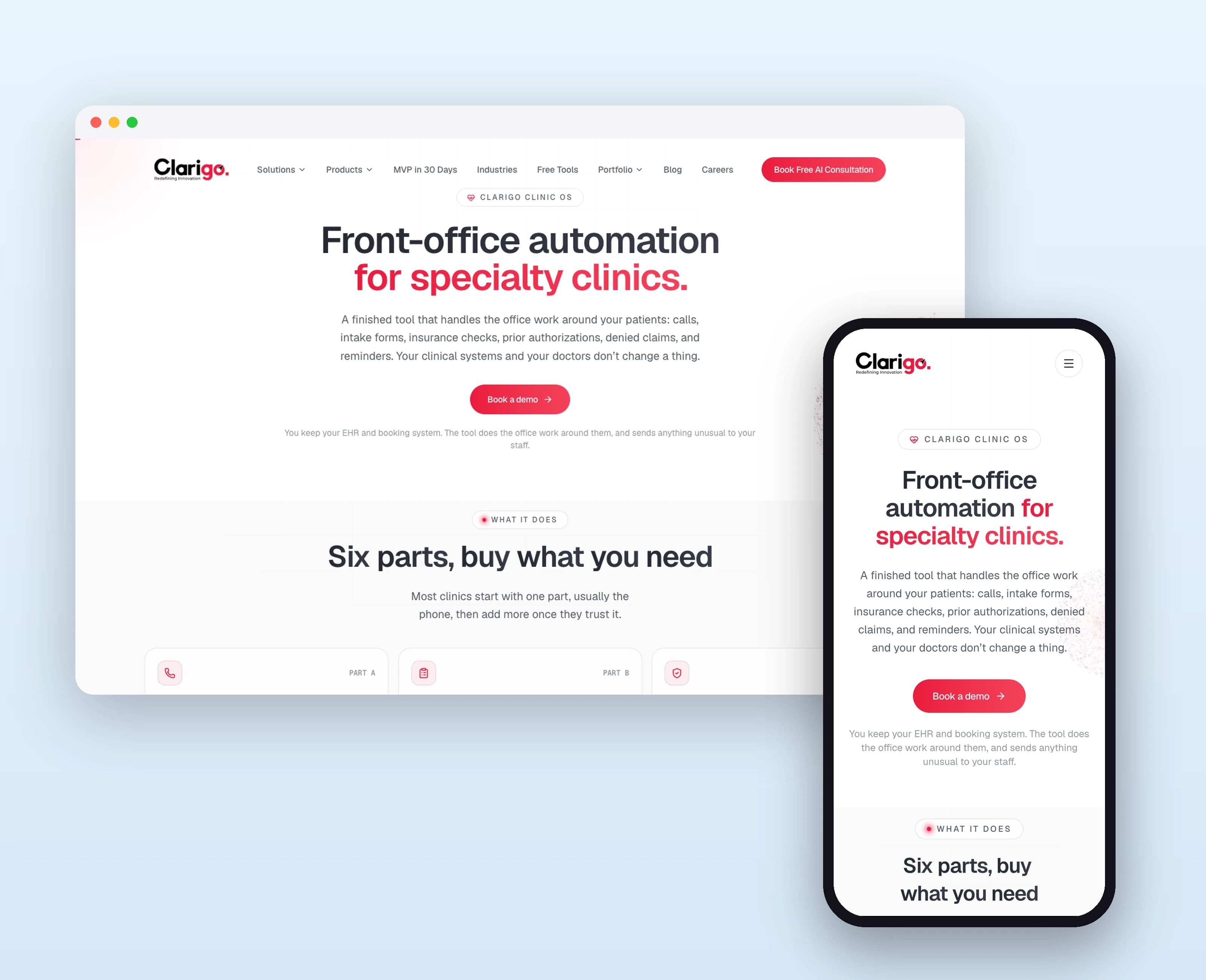
Clarigo Infotech builds HIPAA-compliant chatbots and AI voice agents for healthcare. They answer patient calls, texts and website chats, book and reschedule appointments, collect intake details and hand over to staff when a person is needed. Our HIPAA-trained team runs PHI only through AI, telephony and hosting services covered by a Business Associate Agreement, keeps a full audit trail, and makes sure nothing medical is decided without a person. Our own Clarigo Clinic OS includes an AI phone assistant in English and Spanish built this way.
10+
Years of delivery
600+
Projects delivered
20+
Countries served
25-30
Days to a live MVP
Get a free consultation
Tell us what you need. A senior engineer replies within one working day.
What our healthcare chatbots and voice agents do
AI phone answering
Voice agents that pick up calls, understand the request, answer common questions and transfer to staff with a summary.
Appointment booking
Book, reschedule and cancel against real availability in your EHR or scheduling system, with confirmations and reminders.
Website and SMS chat
Chat on your website and text messages for opening hours, directions, preparation instructions and visit requests.
Intake and insurance details
Collect demographics, reason for visit and insurance information before the visit, ready for staff to review.
Safe escalation
Clear rules that route urgent symptoms, clinical questions and upset callers to a person straight away.
Audit and review
Transcripts, actions and hand-offs logged for every conversation, with a review screen for staff.
How we approach HIPAA-compliant chatbots
What makes a chatbot HIPAA-ready
There is no HIPAA-certified chatbot. What matters is how PHI flows: every service that receives it (the language model, speech-to-text, telephony, SMS and hosting) must be covered by a BAA and configured not to retain or train on the data. Add unique staff logins, encryption, audit logs and minimum-necessary prompts, and the chatbot becomes a system you can defend in a risk analysis.
Keep the AI away from medical decisions
A front-desk assistant should schedule, inform and collect, not diagnose. We give it a narrow job, ground answers in your approved content, and hard-code escalation for emergencies, symptoms and medication questions. Callers describing an emergency are told to call emergency services and are put through to staff. Anything medical or financial is approved by a person, and the assistant says clearly that it is an automated assistant.
Voice is harder than chat
Phone calls add speech recognition errors, accents, background noise and people talking over the assistant. We test with real call recordings (with permission) and scripted edge cases, confirm key details back to the caller, spell out names and dates, and transfer to a person after a set number of misunderstandings rather than looping. Every call is transcribed and logged, so staff can see exactly what was said and done.
Connecting to the schedule
A booking assistant is only useful if it books real slots. We connect to your EHR or practice management system through FHIR Appointment and Slot resources where available, or the vendor's scheduling API, and apply your rules for visit types, providers, new versus returning patients and buffers, so staff do not have to fix bookings later. Where write access is not available, the assistant creates a request for staff to confirm.
How it works
Week 1: discovery and PHI mapping
We map every place patient data is created, stored and sent, agree the minimum data each feature needs, and confirm BAAs with every vendor that will touch PHI.
Weeks 2-3: build and integrate
Senior engineers build in short sprints with access control, encryption and audit logging from day one, connect your EHR and other systems, and demo every week.
Week 4: test, security checks and launch
We test with realistic de-identified data, run security checks on access, logging and encryption, fix what they find, then deploy to your own HIPAA-eligible cloud account.
After launch: 24/7 support
The same team stays on with 24/7 support, monitoring, patching and new features, and keeps the security documentation up to date as the product changes.
See what we've built
Try it yourself, free
Free browser tools from our team. No sign-up needed.
Questions we hear most
Can a chatbot be HIPAA compliant?+
Yes, when every service that handles PHI is covered by a BAA and configured not to retain or train on it, access is controlled and logged, and the clinic's policies cover its use. Compliance comes from the whole setup, not a label on the chatbot.
Can we use ChatGPT-style models with patient data?+
Only through an offering whose provider signs a BAA, configured so the data is not used for training. Consumer chat apps are not suitable for PHI. We check the current BAA terms for each model provider we propose.
Can the AI answer the phone?+
Yes. A voice agent can answer calls, book or move appointments, answer common questions and transfer to staff with a summary. Clarigo Clinic OS includes an AI phone assistant in English and Spanish.
Will it give medical advice?+
No. We design it to schedule, inform from your approved content and collect details. Symptoms, medication and clinical questions go to a person, and callers describing an emergency are directed to emergency services.
How long does it take to build?+
A focused assistant for one channel, such as phone booking or website chat, usually goes live in 25 to 30 days. Adding more channels, languages and EHR write-back follows in phases, with 24/7 support after launch.