
Healthcare app development
Healthcare app development company: secure apps for patients, clinicians and staff.
Clarigo Infotech is a healthcare app development company in Indore, India, with 10+ years of delivery and a HIPAA-trained team. We build patient apps and portals, telehealth, AI assistants for the front desk and tools for clinicians and staff, on web and mobile. Every app is designed around protected health information from the start, with role-based access, encryption, audit logs and HIPAA-eligible hosting, and connects to your EHR through HL7 and FHIR. A focused first version usually goes live in 25 to 30 days, and you own the source code.
10+
Years of delivery
600+
Projects delivered
20+
Countries served
25-30
Days to a live MVP
Get a free consultation
Tell us what you need. A senior engineer replies within one working day.
What our healthcare app development covers
Patient apps and portals
Booking, digital intake, secure messaging, results, reminders and payments on iOS, Android and the web.
Telehealth
Video visits, virtual waiting rooms, scheduling and follow-up, built on video services that sign a BAA.
AI front desk
AI assistants that answer calls and messages, book appointments and hand over to staff, with PHI handled safely.
Clinician and staff tools
Dashboards, task lists, documentation helpers and care-team messaging that fit how your clinic already works.
EHR integration
Read and write patient, appointment and clinical data through FHIR APIs and HL7 messages, so nobody types it twice.
Our own products
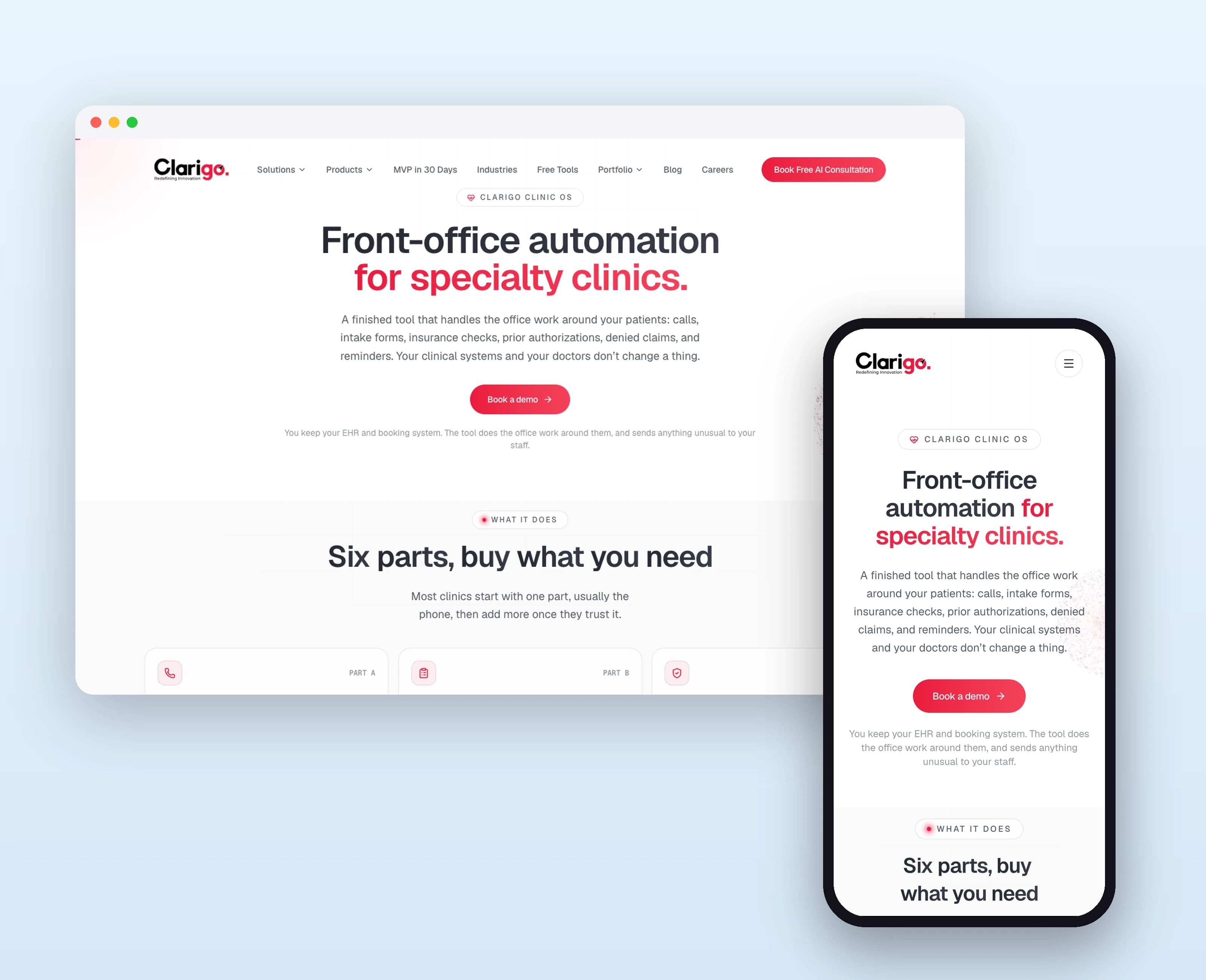
Clarigo Clinic OS for front-office automation and Clarigo EHR for cloud records with an AI scribe, or a custom build.
How we approach Healthcare app development
Does HIPAA apply to your app?
HIPAA applies to covered entities (health plans, clearinghouses and providers that bill electronically) and to business associates that handle PHI on their behalf. An app a clinic gives its patients is in scope; a consumer wellness app the user downloads on their own may not be, though other privacy and health-breach rules can still apply. We confirm which applies before design, because it changes hosting, vendors and contracts.
Design around the minimum necessary
The easiest PHI to protect is the PHI you never collect. During design we decide which screens, notifications and analytics events actually need patient data. Push notifications and emails say "You have a new message" rather than the diagnosis, analytics tools receive no PHI, and staff roles see only the records their job requires. This is the HIPAA minimum necessary standard applied to product design.
Mobile-specific risks
Phones get lost and shared. We keep PHI out of device logs and screenshots where possible, store tokens in the platform's secure storage, support biometric unlock with automatic session timeout, and avoid caching records on the device unless the use case needs offline access, in which case the local data is encrypted. Signing out, or a remote session revoke by staff, clears what the app holds.
Plan integrations first
In healthcare projects, the EHR integration usually decides the timeline. Access to production APIs can involve the EHR vendor's app registration, the clinic's approval and testing in a sandbox. We start that work in week one, build against sandbox data while approvals run, and ship features that do not depend on the integration first. That way a slow approval delays one feature, not the whole launch.
How it works
Week 1: discovery and PHI mapping
We map every place patient data is created, stored and sent, agree the minimum data each feature needs, and confirm BAAs with every vendor that will touch PHI.
Weeks 2-3: build and integrate
Senior engineers build in short sprints with access control, encryption and audit logging from day one, connect your EHR and other systems, and demo every week.
Week 4: test, security checks and launch
We test with realistic de-identified data, run security checks on access, logging and encryption, fix what they find, then deploy to your own HIPAA-eligible cloud account.
After launch: 24/7 support
The same team stays on with 24/7 support, monitoring, patching and new features, and keeps the security documentation up to date as the product changes.
See what we've built
Try it yourself, free
Free browser tools from our team. No sign-up needed.
Questions we hear most
How much does it cost to build a healthcare app?+
It depends on features, platforms and integrations. After a free consultation you get a fixed quote for a defined scope. Senior engineers at Clarigo Infotech are typically US$25 to $49 per hour, and a focused first version usually goes live in 25 to 30 days.
Is your team experienced with HIPAA?+
Yes. Our team is HIPAA-trained and has 10+ years of delivery, with HL7 and FHIR integration experience. We build access control, encryption, audit logging and BAA-covered hosting into the app from the start rather than adding them later.
Can you build for both iOS and Android?+
Yes. We usually use React Native or Flutter to ship both from one codebase, and native Swift or Kotlin when a feature needs it. A web portal can share the same back end and security model.
Will the app connect to our EHR?+
Usually, yes. Most modern EHRs offer FHIR APIs, and many also exchange HL7 v2 messages. We check what your EHR supports and what access approval it needs during discovery, because that shapes the timeline.
Who owns the code?+
You do. You get full source-code ownership, and the app is deployed to your own cloud account under your own BAA with the hosting provider. The same team can stay on afterwards with 24/7 support.